We asked movement professionals 19 questions about their work: what is hard right now, and what is getting in the way. We were not selling anything.
163 people answered. Here is what they said.
Before the numbers: who these 163 people are
Read the findings with this in mind.
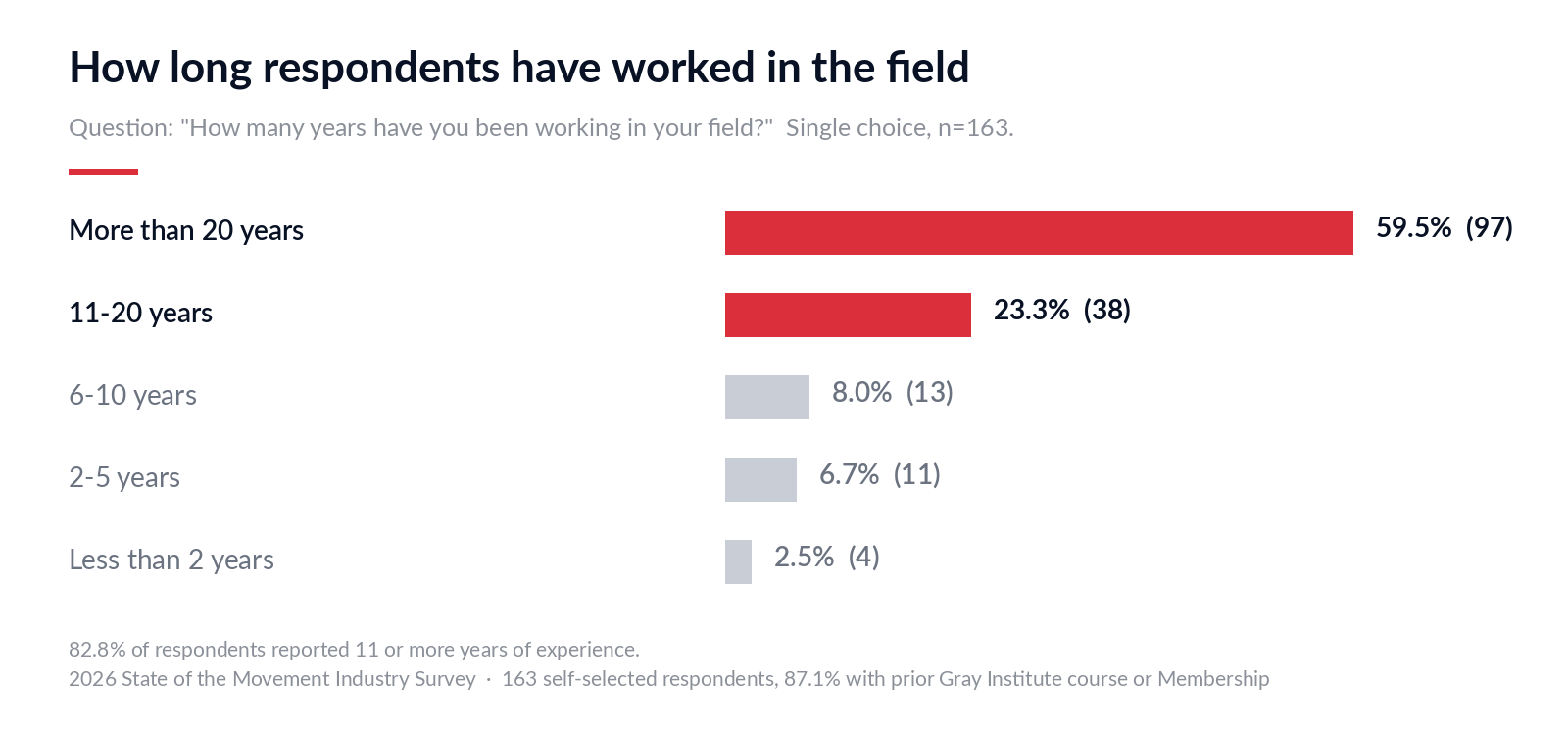
- 82.8% have 11 or more years in the field. 59.5% have more than 20.
- 50.3% are physical therapists or PT assistants. 22.7% are personal trainers or group fitness instructors.
- 49.7% pay for all their own training. 13.5% have an employer who covers all of it.
- The most common yearly spend on continuing education is $500 to $1,500 (44.8%).
- 87.1% had completed a Gray Institute course or held a Membership before.
We invited responses by email and on social media. Anyone who works with human movement could answer, and people chose whether to take part.
So read every number below as “what these 163 people reported.” This group is experienced, and most of it already knows us. It cannot tell you what the movement industry as a whole thinks, what newer professionals think, or what the full Gray Institute community thinks. It is honest feedback from a specific set of people.
The short version
1. Most reported being fairly sure they understand why their work works. 8 was the most common score out of 10.
2. Declining reimbursement or pricing pressure was the most-selected current challenge. Burnout tied for second.
3. Asked in their own words what stands between them and their professional goals, time and capacity was the most common barrier — named more than twice as often as cost.
4. 48.5% chose relationships as the answer closest to their view of who will thrive.
5. The two most-selected five-year goals were teaching or mentoring and being the person others send hard cases to.
Finding 1
Sure — but not completely sure
We asked: how confident are you that you understand WHY your interventions work, when they work?
Scale of 1 to 10. This measures confidence in explaining the mechanism. It does not measure whether the work is effective, or confidence across every part of practice.
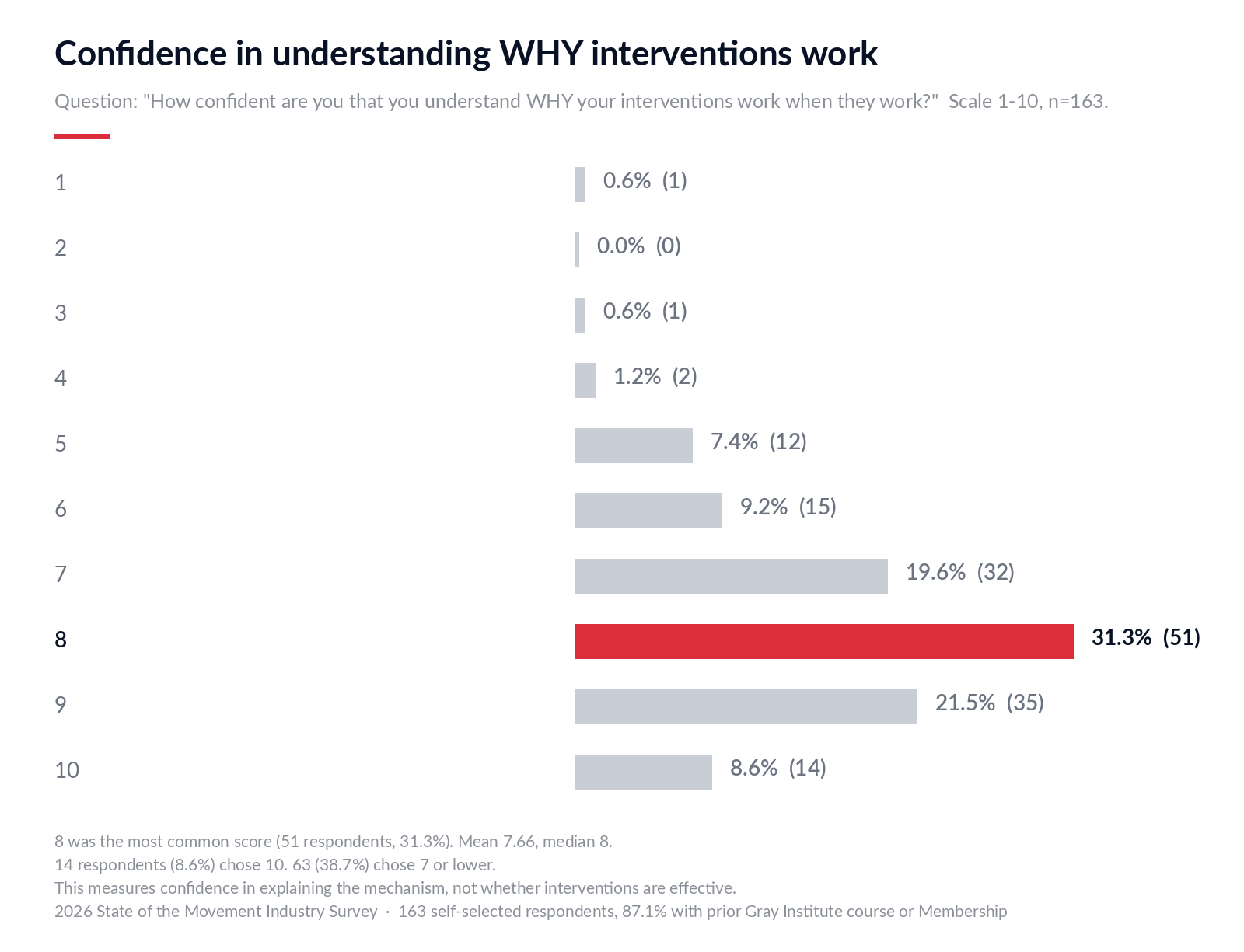
The most common score — 31.3% chose it.
14 people (8.6%) chose 10. · 63 people (38.7%) chose 7 or lower.
Most of this group trusts its own reasoning and knows that trust is incomplete.
That gap between “I get results” and “I could explain exactly why” comes up again in Findings 2 and 9.
Finding 2
What people say they do when a case stops responding
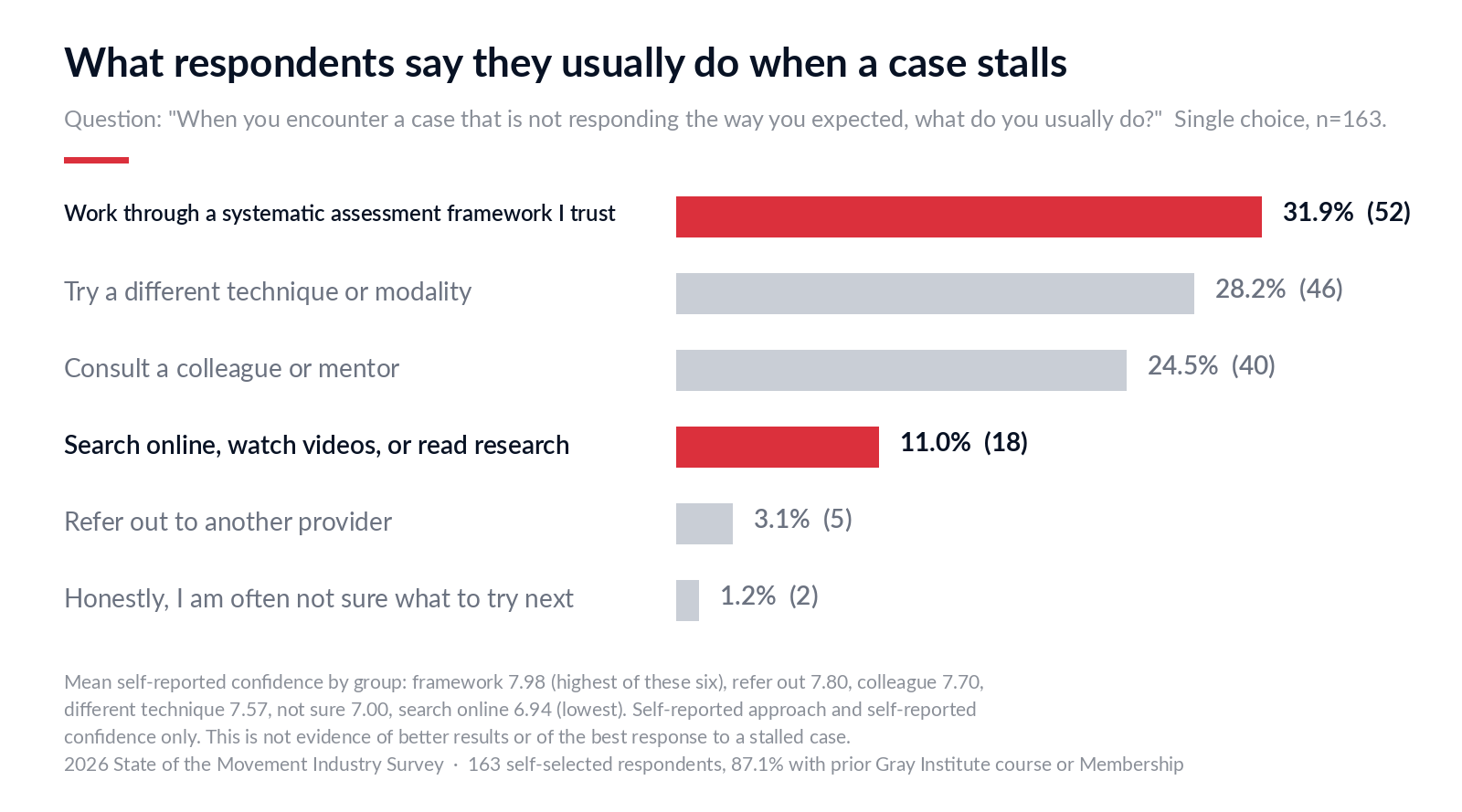
Only 2 people out of 163 said they are often not sure what to try next.
Among these six groups, the people who selected “work through a systematic assessment framework I trust” reported the highest average confidence (7.98).
The people who selected “search online, watch videos, or read research” reported the lowest (6.94).
What this is not. This is a self-reported usual approach lined up against a self-reported confidence score. It does not show who gets better results, and it does not show which response to a stalled case works best. We did not observe a single treatment decision or outcome.
Having somewhere to go may matter more than having one more thing to try.
Finding 3
What makes the work hard right now
Respondents could select up to three.
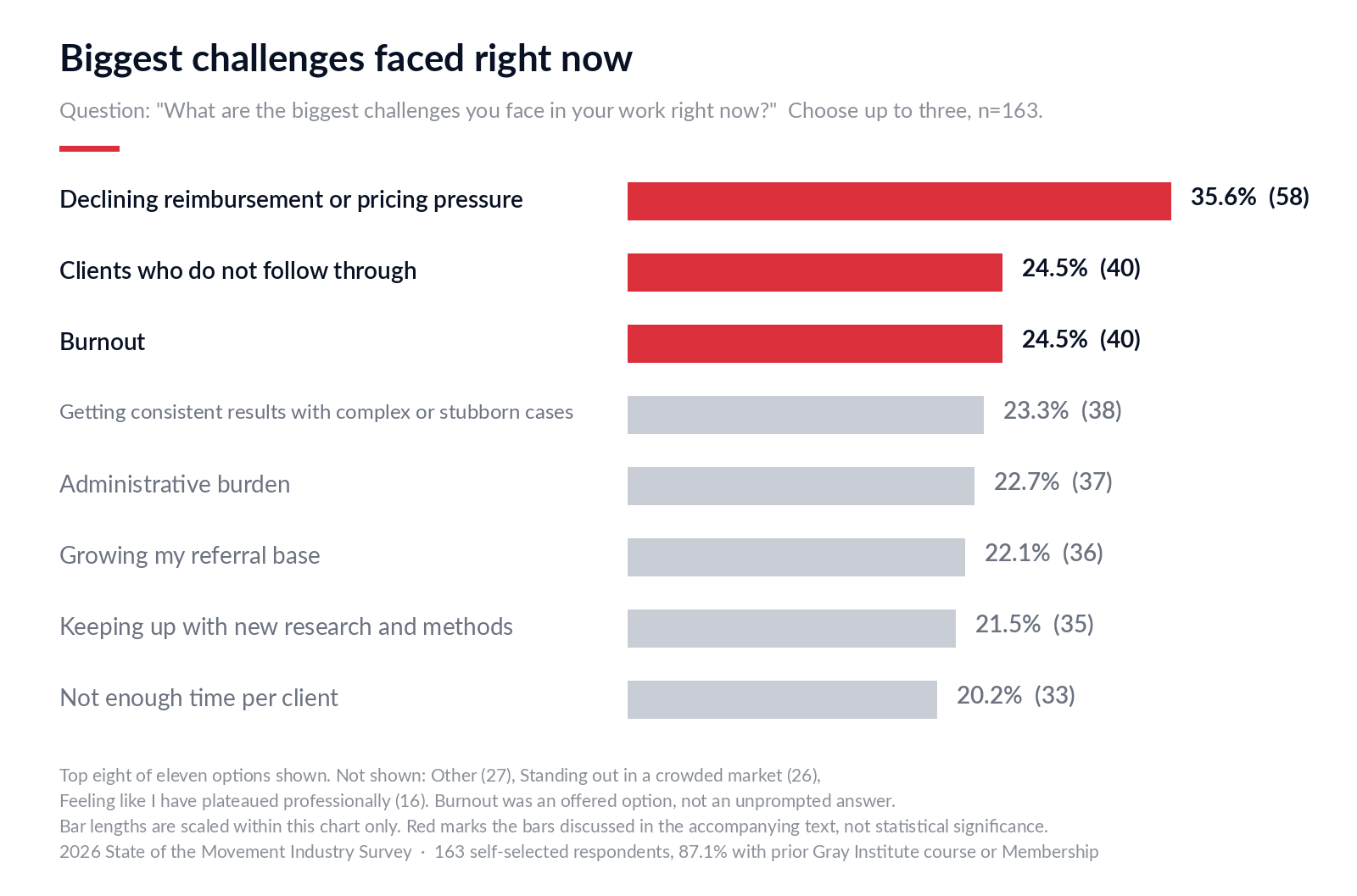
Declining reimbursement or pricing pressure came first, selected by 58 people (35.6%).
That option deliberately covers two different squeezes — insurance reimbursement, and pricing pressure on cash-pay, training and coaching work. We cannot tell the two apart from this data.
Burnout tied for second at 40 people (24.5%) — level with clients who do not follow through, and just ahead of getting consistent results with complex or stubborn cases (38).
Burnout was one of the options we offered, so this is not something people raised unprompted. And this was a single checkbox, not a validated burnout measure. Roughly one in four chose it as one of their three biggest current challenges — which is more than we expected to see on a list where every other option was about the work itself.
Finding 4
In their own words: time
We asked one open question: “In your own words, what is standing between you and that goal?”
It was optional. 128 of 163 people answered it — 78.5%.
We read all 128, including the one-word answers, and coded them into themes. A single answer often carries more than one theme, so these do not add to 100%.
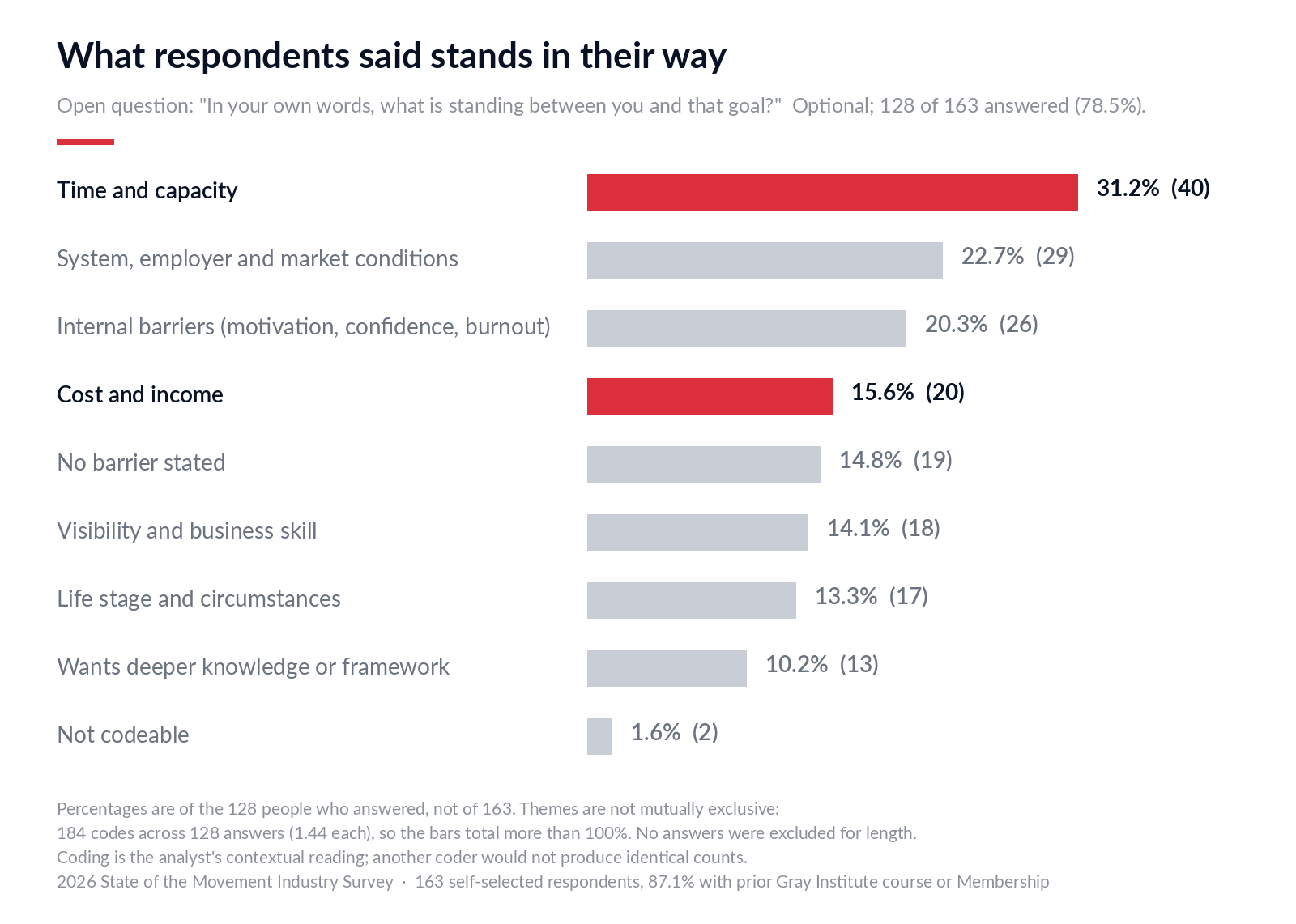
Time and capacity was the most common theme: 40 of 128 responses (31.2%). Cost and income came up in 20 (15.6%) — less than half as often.
Nineteen people said nothing was standing in the way. Two answers could not be coded.
Two people described it this way:
“Time. I have long days with some days, as many as 10-12 clients per day. I work 7 days a week. I have the access to my 3DMAPS, Chain Reaction, and CAFS but it is difficult to find time to review and apply what I learned while working so many hours.”
“Time and resources; I want to complete so many educational courses still but also need to start my business. Finding the time to do both while caring for a family and still working in an insurance based clinic to pay bills and raise funds to accomplish those goals.”
A note on how we counted. These themes are our reading of what people wrote. We wrote down a definition for each theme first, then assigned every one of the 128 answers, and an answer could land in more than one theme. Someone else reading the same 128 answers would not land on exactly the same numbers.
Finding 5
One answer we are still sitting with
One person wrote this:
“Having the confidence to be able to explain why I do what I do. I have extensive coursework with Gray Institute but still feel like I struggle to justify what I am doing to my coworkers since it does go against the grain on what is ‘standard practice.’”
We are not going to tell you what this means, because we do not know. It could be about explaining under pressure, the culture of one workplace, or something our own teaching has not covered well enough. It could be all three.
And if you recognize yourself in that quote: two other people described working without colleagues who share their approach — one named the lack of “a network of peers with the same vision.” Three written answers out of 128 is a small number, but you are not the only one.
Finding 6
What people expect to change
We asked which changes will most affect how movement professionals work over the next five years. Up to three selections.
selected AI and automated assessment — the most-selected answer.
An aging population with complex needs was next, at 39.3%.
Then we asked if they feel prepared.
| Yes — I feel ahead of the curve | 24.5% |
| Somewhat — I am aware but not actively preparing | 53.4% |
| Not really — I know I should be doing more | 19.6% |
| No — I feel like I am falling behind | 2.5% |
53.4% described themselves as aware but not actively preparing. Adding in the two groups below that, 75.5% did not describe themselves as ahead of the curve — though feeling behind is not the same as doing nothing.
Given what the same group said about time, we would not call that complacency.
Finding 7
The skill they put first
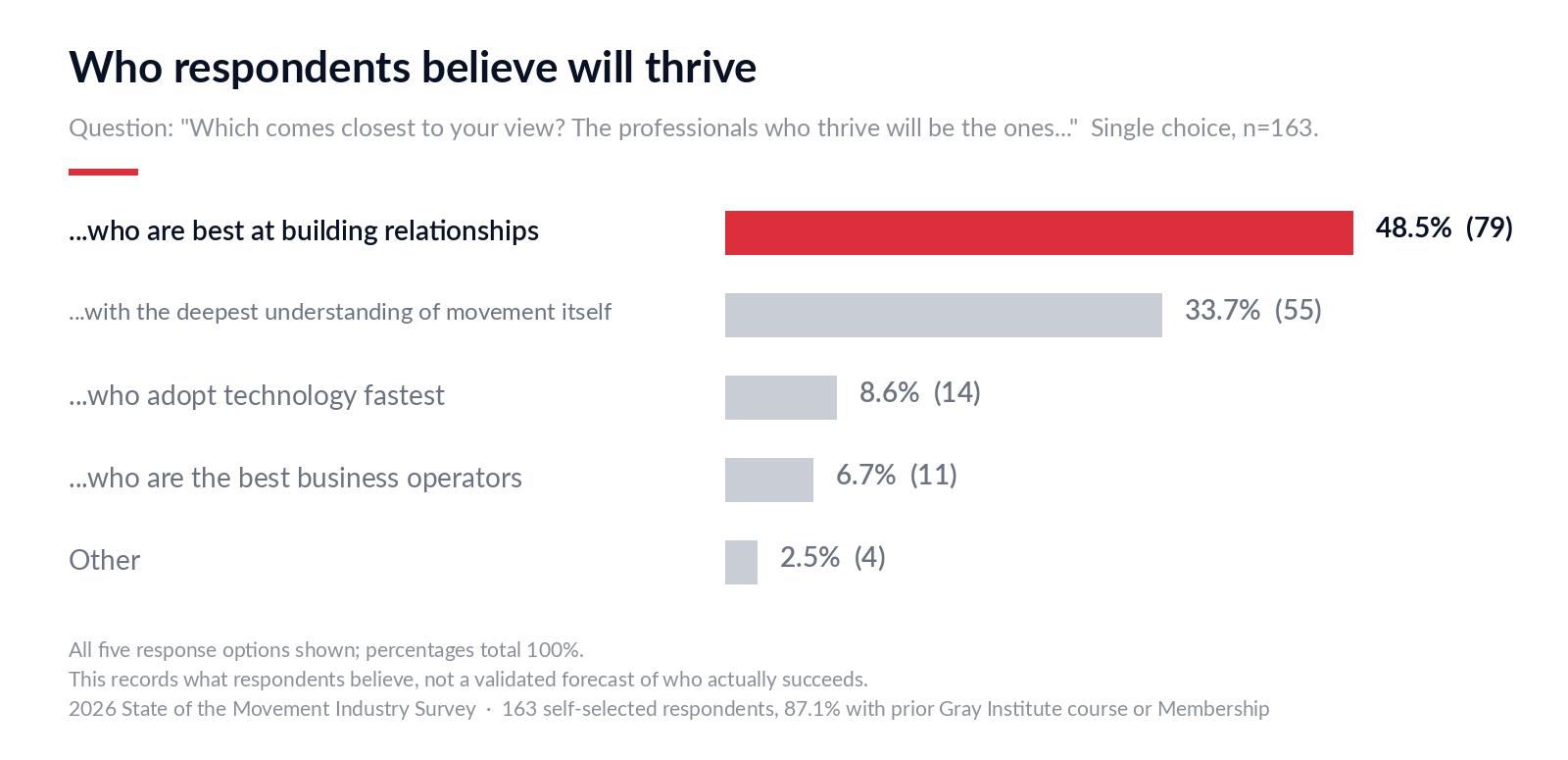
48.5% chose relationships as the answer closest to their view — about 15 points ahead of deep movement knowledge. (Four people chose “Other”: 2.5%.)
This question asked what respondents believe about who will thrive.
In real work the two cannot be separated. We forced the choice anyway, because a professional who does not recognize that relationship skill matters will never set out to improve it.
This group recognizes it.
Where we stand on this
What follows is Gray Institute’s position, not a survey finding.
Our read of movement education generally — ours included, historically — is that it leans heavily on mechanics: assessment, progression, technique, tissue. Much less of it addresses:
- How to reach a person who does not want to be there
- How to encourage someone through the weeks when nothing is working yet
- How to give a client the confidence to continue without you
We think those are teachable skills.
Applied Functional Science® is built on three sciences, not one:
| Physical science | Gravity, ground reaction, mass, momentum |
| Biological science | Anatomy, physiology, how a joint really behaves |
| Behavioral science | Motivation, fear, and the power of the mind and spirit |
The third is one of the three legs the whole thing stands on. We call the practice of it the three E’s — engage, encourage, empower.
We teach it on purpose. A professional who reads a chain reaction perfectly but cannot reach the person attached to it has not finished the job.
So when nearly half of you named relationships as the thing that decides who thrives, it told us we are pointed the right way. We will keep making it a priority.
One more thing about this finding
People who chose relationships reported similar average confidence to people who chose movement knowledge: 7.51 versus 7.67. Whichever answer someone gave, they rated their own understanding about the same. These do not look like two different kinds of professional.
Finding 8
Where people want to be in five years
Respondents could select up to two.
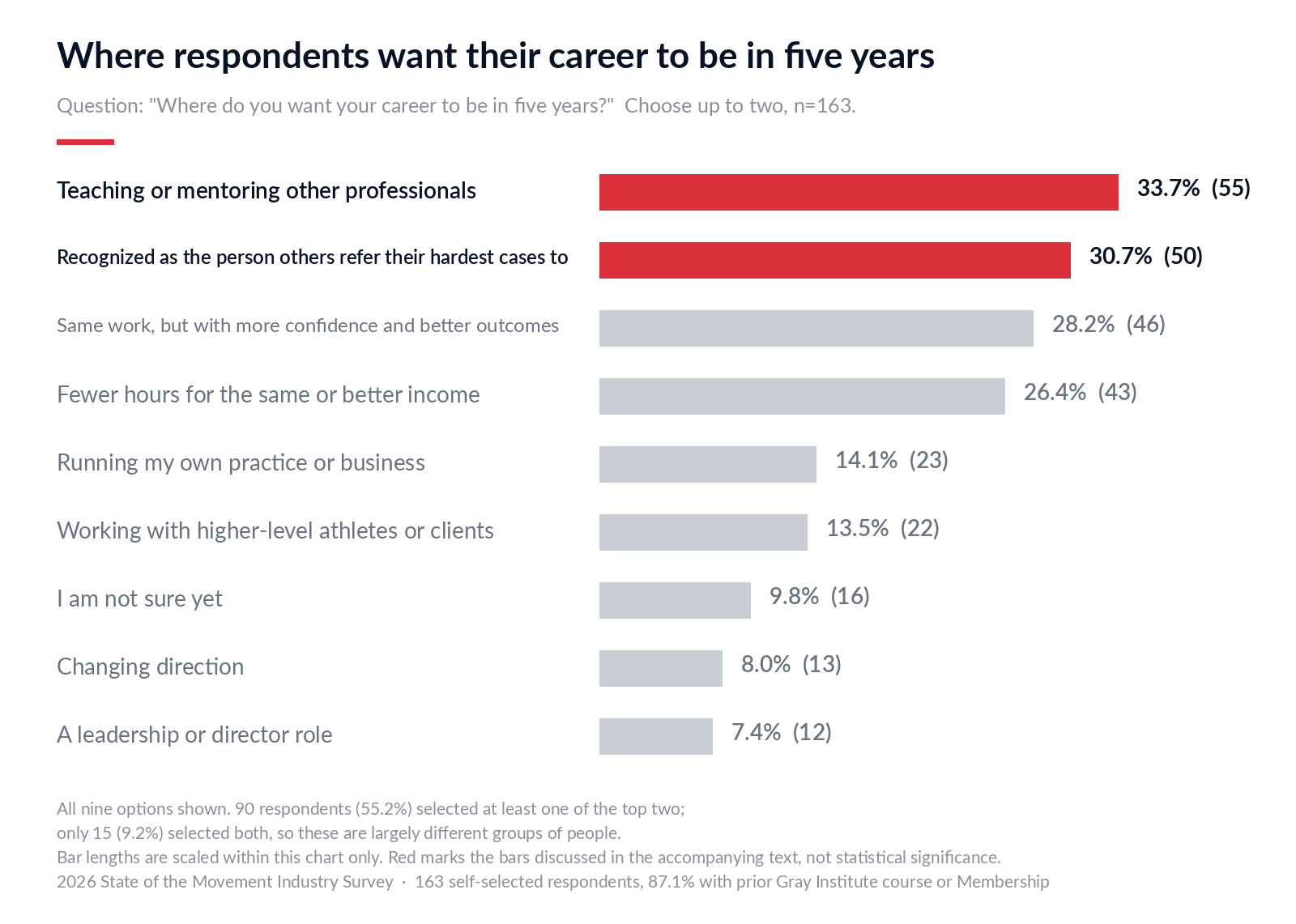
The two most-selected goals were:
- Teaching or mentoring other professionals — 55 people (33.7%)
- Recognized as the person others refer their hardest cases to — 50 people (30.7%)
90 people (55.2%) selected at least one of the two. Only 15 (9.2%) selected both — so these are mostly two different groups of people, not one group wanting both things.
Both describe becoming the person in the room who knows.
Finding 9
Does training change anything?
We compared confidence scores between two groups: the 142 people who reported completing a Gray Institute course or holding a Membership, and the 21 who reported neither.
| Course or Membership (142 people) | 7.80 |
| Neither (21 people) | 6.76 |
About one point apart on a ten-point scale — a gap large enough that it is unlikely to be chance.
A second difference showed up in what people said they do. Asked what they usually do when a case stalls:
Course or Membership group: 51 of 142 — about 1 in 3 — chose “work through a systematic assessment framework I trust.”
Neither group: 1 person out of 21 chose “work through a systematic assessment framework I trust.”
We also checked whether the first group simply had more years in the field. The pattern barely changes once experience is accounted for.
What this does not prove
- Ruling out experience does not rule out everything else. Role, work setting, prior education and motivation were not accounted for.
- The 21 are not strangers to us. 18 already knew Gray Institute but had not taken a course or held a Membership. Only 3 were new to us.
- People who seek out this kind of education probably already want to know why. The curiosity likely comes first.
- Confidence is self-reported. Feeling sure is not the same as being right. We did not measure a single outcome.
- 21 people is a small comparison group, and that second comparison rests on one person.
- This is a pattern inside our own community. It is suggestive, not established, and would need a larger study to confirm.
Two things are true in this sample: people who had taken a course or held a Membership reported higher confidence, and far more often said they work from a framework they trust.
What this survey cannot tell you is why — whether the education did that, or whether the people already inclined that way are the ones who seek it out.
Finding 10
A challenge, from one of you
Three people used the open question from Finding 4 — “In your own words, what is standing between you and that goal?” — to raise something larger than their own circumstances.
One of them asked a question about the next generation:
“The Gap between newer PTs graduating and true clinical excellence. Will the next generation have enough motivation to take on the necessary training to get better.”
Two others, answering the same question, described the conditions that make choosing well difficult:
“…Information overload from CE options, making it hard for me to choose what’s most relevant.”
“Too easy access to CECs/CEUs and information online, regardless of quality… Everyone has gotten on the cec provider bandwagon.”
What we make of it
Everything in this part of the section is Gray Institute’s opinion. It is not a survey finding, and nothing above establishes it.
Getting better has never been easier to access. It has also never been easier to confuse consuming with learning.
There is more education available now than at any point in the history of this profession. That sounds like progress, and mostly it is. But when everything is available, nothing is obviously worth choosing — and faced with a hundred reasonable options and no way to rank them, most of us freeze. Then the renewal date arrives, the hours are due, and we click through something. We finish it. We learn nothing.
We cannot show you from this data that collecting hours without building understanding harms anyone. We believe it does.
Real learning is slower and less comfortable. It means being wrong in front of someone. Going back. Thinking again.
It means using all the evidence — the research you were taught, and the person in front of you. That person is evidence too. And they are the only one in the room whose outcome you are responsible for.
One number that cuts against the worry
Back to the data. We also asked: “When you consider a significant investment in your professional development, what matters most?” Single choice, one answer each.
54.0% chose depth — will it fundamentally change how I work.
1.8% (3 people) chose a recognized certification.
Forced to pick one thing, this group picked depth. The open question is whether the people coming up behind them will say the same.
What we are doing with this
Time and capacity is the most common barrier — and most of it is not ours to fix.
It showed up in 40 of 128 written answers. But it is mostly family, second jobs, paperwork, and clinics running 10 to 12 patients a day. Those are job and life problems, not course problems. We would be flattering ourselves to claim otherwise.
If hours are the scarcest thing you have, every hour of education has to earn its place.
Sequencing — thank you for the confirmation.
One of you wrote asking for help deciding where to start, based on what the assessment and the body actually give you. Over the past year we added more than 100 short videos to the Treatment & Training Techniques library for exactly that reason. Reading it come back to us unprompted told us we had read the need correctly. We will keep building there.
Working differently can be isolating.
A small number of people described working without colleagues who share their approach. It was a small number of people, and we want to build for it.
Depth over credentials. You were clear about which matters more, and that shapes what we build.
Thank you
The multiple-choice questions take about five minutes. The average person spent 12 minutes and 11 seconds — which means more than seven of those minutes went into writing answers nobody required them to write. 128 of you did that. Some wrote several paragraphs about work that is clearly hard right now.
We read every one. Including the one-word ones.
We want to be specific about what that is worth, because “thank you for your feedback” is what organizations say when feedback goes nowhere. These answers are already shaping:
- What we build next
- How our mentorship supports people between sessions, not only during them
- How our own team is trained to hear what you are actually dealing with
The size of the time problem in particular is something we had underestimated.
Taking twelve minutes to think carefully about your own practice, when nobody makes you, is itself a signal. The professionals who invest that time are usually the ones already trying to get better. If that is you, the findings above are partly a picture of your own peer group.
Most of what makes this work hard is invisible from inside one clinic. A fair number of the people around you are carrying the same thing.
Responses collected from August 31 – September 30, 2026. 163 responses. Participation was voluntary and self-selected, so these results describe the people who answered and cannot be generalized to the movement industry as a whole. Some questions allowed more than one answer, so those percentages add to more than 100%. Individual responses are confidential; written answers are quoted as submitted, with names and direct identifiers removed. Distinctive details may still be recognizable to someone who knows the person, so we have limited quotation accordingly.